- Loading...
- Loading...



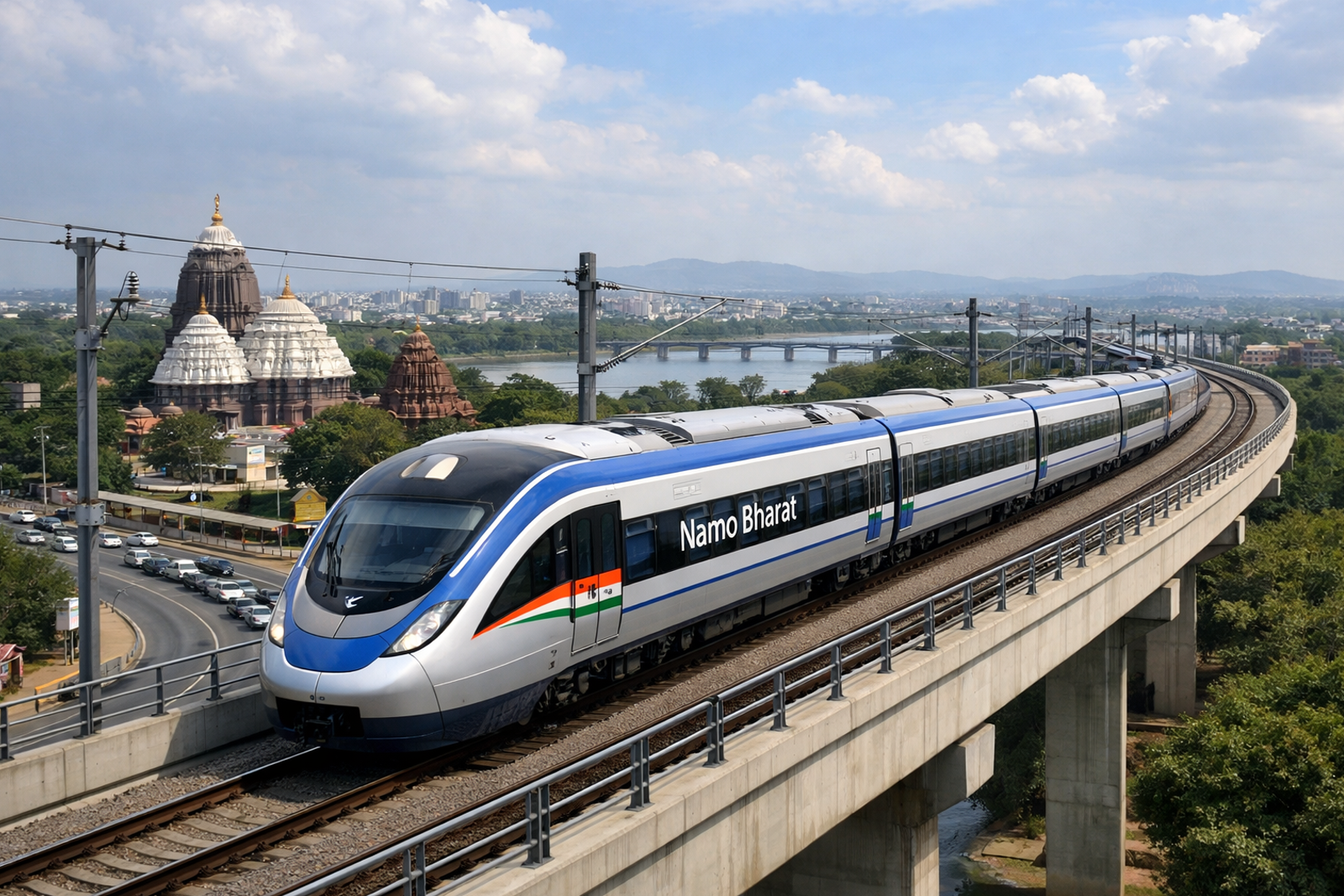
The Central government is exploring the possibility of introducing the Namo Bharat Rapid Rail corridor between Bhubaneswar and Cuttack, aiming to enhance high-speed regional connectivity in Odisha. The proposal, currently under consideration, is expected to strengthen transport infrastructure and support the rapid urban growth of the twin cities.
Bhubaneswar and Cuttack, often referred to as Odisha’s twin cities, are closely linked in terms of administration, commerce, and daily commuting. Thousands of people travel between the two cities every day for work, education, and business activities. A rapid rail corridor could significantly reduce travel time while offering a comfortable and reliable alternative to road transport.
The Namo Bharat rapid rail system is designed to provide faster intercity travel with modern trains, advanced safety systems, and dedicated tracks. If implemented, the project would likely transform the commuting experience between the two cities by offering high-frequency services and improved passenger facilities.
Transportation experts believe that a rapid rail corridor could play a key role in boosting economic development in the region. Faster connectivity would make it easier for businesses, professionals, and tourists to move between the two urban centres, supporting trade and investment opportunities.
The project could also encourage planned urban expansion along the corridor, leading to the development of new residential and commercial hubs. Improved public transport infrastructure often contributes to reduced traffic congestion and lower pollution levels in busy urban areas.
Officials are currently reviewing the feasibility of the proposal, including possible routes, costs, and expected passenger demand. If approved, the Bhubaneswar–Cuttack corridor could become one of the significant regional transport initiatives in eastern India, strengthening Odisha’s position in modern urban mobility development.
The Central government is examining a proposal to introduce the Namo Bharat Rapid Rail corridor connecting Bhubaneswar and Cuttack, a project that could transform regional transportation in Odisha. If implemented, the high-speed rail service would provide faster, reliable, and modern connectivity between the two closely linked urban centres, often referred to as the twin cities of the state.
The idea of introducing a rapid rail system between Bhubaneswar and Cuttack comes at a time when both cities are witnessing rapid population growth, increased economic activity, and rising commuter demand. A dedicated rapid rail corridor could significantly reduce travel time while easing traffic pressure on existing road networks.
Bhubaneswar, the capital of Odisha, and Cuttack, the state’s historic commercial hub, are located about 25–30 kilometres apart. Despite the short distance, daily commuters often face traffic congestion during peak hours on major roads and highways connecting the two cities.
Key reasons behind the need for improved transport infrastructure include:
Growing population in both cities
Increased daily commuting for employment and education
Expansion of business and industrial activities
Rising vehicle numbers leading to traffic congestion
A rapid rail corridor like Namo Bharat could provide a high-capacity public transport option that allows passengers to travel quickly and comfortably between the cities.
The Namo Bharat Rapid Rail system is designed as a modern regional rapid transit network aimed at connecting major urban centres with surrounding regions. Unlike conventional railways or metro systems, rapid rail corridors are built specifically for medium-distance high-speed travel.
Some important features of the system include:
High-speed trains: Designed to run at speeds of up to 160 km per hour
Dedicated rail tracks: Ensuring smooth and uninterrupted operations
Modern stations: Equipped with digital ticketing, security systems, and passenger amenities
Frequent services: Trains operating at short intervals during peak hours
Comfortable travel: Spacious coaches with improved seating and facilities
These features make the system suitable for connecting cities that are relatively close but experience heavy commuter traffic.
If the proposed rapid rail corridor becomes a reality, it could bring several long-term benefits for Bhubaneswar and Cuttack.
One of the biggest advantages would be faster travel. The journey between the two cities could be completed in significantly less time compared to current road travel, especially during rush hours.
With a reliable public transport alternative, many commuters may shift from private vehicles to rapid rail services. This shift could help reduce traffic congestion on major roads.
Students, office workers, and business professionals who travel daily between the cities would benefit from predictable travel schedules and comfortable journeys.
Public transport systems like rapid rail help reduce fuel consumption and vehicle emissions, contributing to better air quality in urban areas.
Infrastructure projects often act as catalysts for economic development, and the Bhubaneswar–Cuttack rapid rail corridor could play a similar role.
Possible economic impacts include:
Increased business activity between the two cities
Better access to employment opportunities
Growth of commercial hubs near rapid rail stations
Attraction of investments and new industries
Faster connectivity also improves logistics and mobility, making cities more attractive for investors and entrepreneurs.
Rapid rail systems frequently lead to the development of new residential and commercial zones along their routes. Areas near stations often experience growth in real estate, retail businesses, and service industries.
In the case of the Bhubaneswar–Cuttack corridor, this could result in:
Planned urban expansion
Development of new housing projects
Growth of shopping and entertainment zones
Improved infrastructure in surrounding areas
Such developments can support balanced urban growth while reducing pressure on already crowded city centres.
Another important aspect of the project would be integration with existing transportation systems. If the rapid rail corridor is developed, planners are likely to ensure connectivity with:
City bus networks
Railway stations
Airports
Metro or future urban transit systems
This integrated transport approach would allow passengers to easily switch between different modes of travel, improving overall convenience.
At present, the proposal is under consideration by central authorities. Before any final decision is taken, several factors will be examined carefully.
These include:
Route alignment and station locations
Estimated project cost
Passenger demand forecasts
Environmental impact assessments
Technical feasibility and construction challenges
Feasibility studies play a critical role in determining whether such large infrastructure projects can be implemented efficiently and sustainably.
The introduction of a rapid rail corridor would represent a major step forward in modernising transportation infrastructure in Odisha. The state has been focusing on improving connectivity through highways, railways, ports, and airports.
If approved, the Bhubaneswar–Cuttack Namo Bharat corridor could become one of the region’s most significant public transport initiatives. It would not only benefit local commuters but also strengthen the state’s position as a growing urban and economic centre in eastern India.
While the project is still in the evaluation stage, the proposal reflects the government’s broader efforts to expand modern transport systems across the country. Rapid rail corridors are increasingly being considered as a solution for connecting growing urban clusters.
For residents of Bhubaneswar and Cuttack, the possibility of a high-speed, efficient rail service offers a glimpse of a future with faster travel, improved mobility, and better urban living standards. If the project moves forward, it could reshape daily commuting and support the continued development of Odisha’s twin cities for decades to come.

In today’s world of endless choices and digital noise, marketing is no longer just about promoting products — it’s about creating meaningful connections. Successful brands focus on building relationships rather than chasing transactions. Marketing that connects transforms audiences into loyal communities by earning their trust, understanding their needs, and delivering genuine value. When businesses prioritize people over promotions, marketing becomes more than strategy — it becomes a relationship built to last.

Odisha’s small businesses are entering a new era — where mobile apps, online payments, and e-commerce aren’t luxuries, but lifelines for growth and survival.

As India enters the second phase of its digital revolution, artificial intelligence and automation are not just transforming industries—they’re redefining what it means to work, earn, and adapt.

The conference brought together officials from ten central districts, including district collectors, tehsildars, registrars, and welfare officers, either virtually or in person.

We glorified sleepless nights, burnout, and exhaustion as signs of ambition. But when did working yourself to the edge become the definition of success?

Not everyone who thrives in tech writes code. Some design the very experiences that make technology human.



Leave Comments