- Loading...
- Loading...


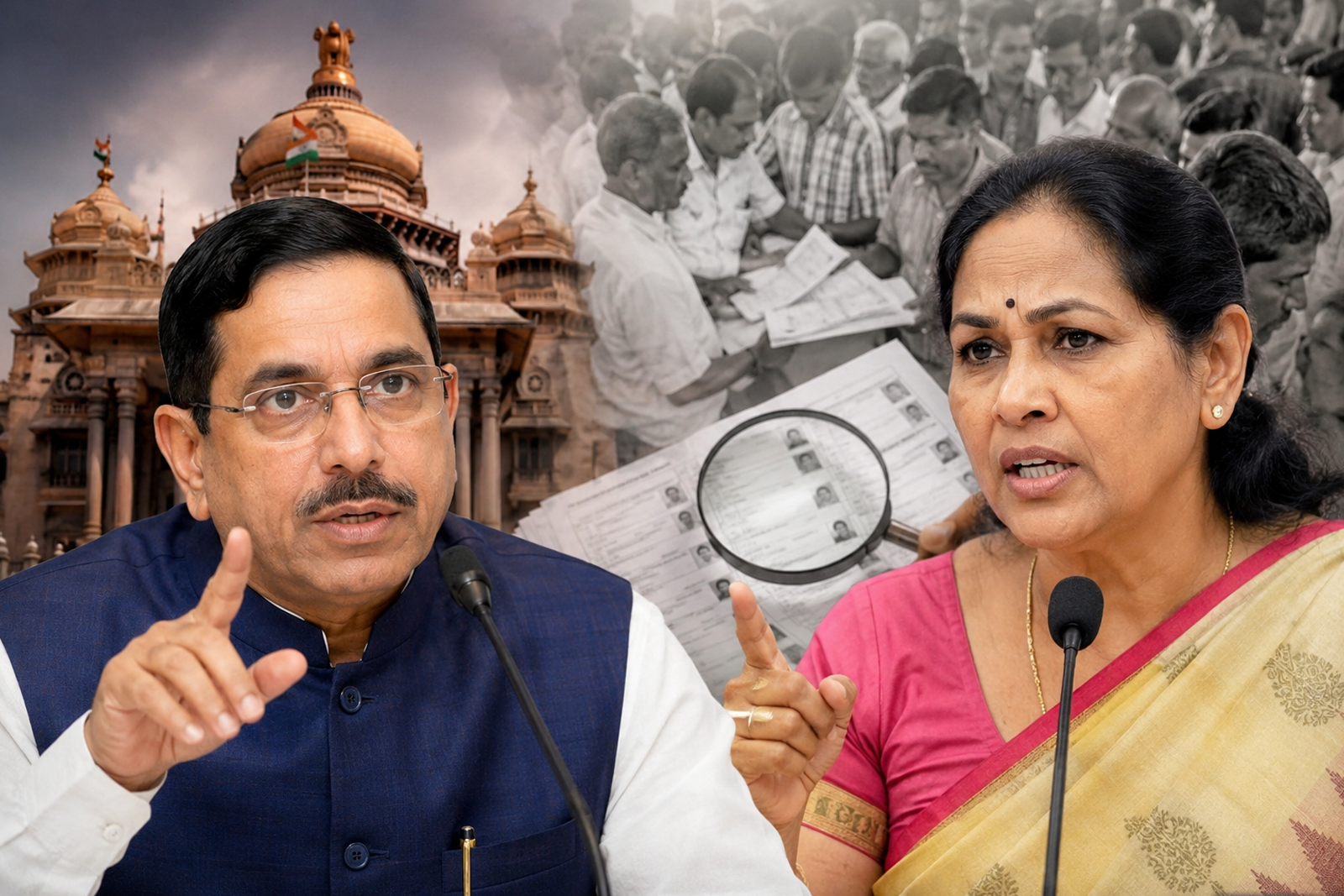
Political tensions in Karnataka have intensified after senior BJP leaders Pralhad Joshi and Shobha Karandlaje accused the state government of allowing widespread irregularities in the Special Intensive Revision (SIR) process. The leaders claimed that several discrepancies have emerged during the verification exercise and demanded immediate corrective measures to protect the integrity of electoral records. Their allegations have triggered a fresh political debate, with both the ruling party and the opposition presenting conflicting narratives.
Addressing the media, BJP leaders alleged that the ongoing SIR exercise has been affected by administrative lapses and inconsistencies. According to them, numerous voter records have reportedly been handled improperly, leading to concerns about transparency and fairness.
The party argued that electoral rolls must be maintained with complete accuracy, as they form the foundation of a democratic election. BJP representatives urged the authorities to conduct a detailed review of the process and rectify any errors before the next electoral exercise.
Pralhad Joshi and Shobha Karandlaje emphasized that public confidence in the electoral system depends on a transparent verification mechanism. They called on election officials to ensure that every eligible voter is included while preventing any wrongful additions or deletions.
The BJP also appealed for stronger monitoring of the revision process, suggesting that digital verification, proper documentation, and public awareness campaigns could reduce the possibility of mistakes.
The allegations have sparked strong political reactions across Karnataka. While BJP leaders insist that the reported irregularities deserve immediate attention, leaders from the ruling establishment have rejected the accusations, maintaining that the revision process is being conducted according to established guidelines.
Political observers believe the controversy could become a major issue in upcoming political campaigns, as electoral integrity remains a highly sensitive topic among voters.
Experts have consistently highlighted that an accurate voter list is essential for conducting free and fair elections. Regular revisions help remove outdated records, update voter information, and include newly eligible citizens. However, the process also requires careful supervision to prevent genuine voters from being excluded or incorrect entries from being added.
The controversy surrounding Karnataka's SIR exercise has once again brought electoral transparency into the national spotlight. As allegations and counter-allegations continue, the focus is likely to remain on ensuring that the revision process is carried out fairly and in accordance with legal procedures. Whether the demands for further scrutiny lead to additional action will depend on the response of the concerned authorities, but the issue has already become a significant point of political discussion in the state.
A fresh political controversy has emerged in Karnataka after senior Bharatiya Janata Party (BJP) leaders Pralhad Joshi and Shobha Karandlaje questioned the conduct of the Special Intensive Revision (SIR) process of electoral rolls. The leaders alleged that the exercise has been marked by widespread irregularities, raising concerns over the accuracy of voter records and the transparency of the revision process. Their statements have intensified the political debate in the state, with the ruling government rejecting the allegations while the BJP continues to demand accountability and greater scrutiny.
The issue has quickly gained political significance because electoral rolls serve as the foundation of India's democratic process. Any dispute regarding voter lists often attracts public attention and becomes a major topic of political discussion ahead of elections.
The Special Intensive Revision (SIR) is a comprehensive exercise carried out to verify and update electoral rolls. Its primary objectives include:
Election authorities periodically conduct such revisions to maintain the credibility of electoral records and improve the efficiency of the voting process.
During interactions with the media, BJP leaders Pralhad Joshi and Shobha Karandlaje expressed concern over what they described as significant shortcomings in the SIR exercise.
According to the party, reports received from various parts of Karnataka indicate inconsistencies in voter verification, documentation, and record maintenance. BJP leaders argued that such issues, if left unresolved, could undermine public confidence in the electoral process.
The party emphasized that electoral rolls should be prepared with complete accuracy and fairness because they directly influence democratic participation.
The BJP outlined several concerns regarding the revision exercise. These allegations include:
The party claimed that verification procedures were not carried out uniformly in every area, resulting in inconsistencies in voter records.
According to BJP leaders, there are complaints suggesting that names of genuine voters may have been removed without adequate verification.
The opposition alleged that several applications and supporting documents were not processed consistently, creating confusion among citizens.
The BJP argued that better supervision and monitoring were required during the revision process to minimize errors.
Party leaders insisted that every stage of voter verification should be transparent so that citizens can verify their electoral status without difficulty.
The BJP has called upon the concerned authorities to undertake a detailed review of the entire SIR exercise.
Among the key demands raised are:
Electoral rolls determine who is eligible to vote during elections. Even minor inaccuracies can create confusion for voters and election officials.
An accurate voter database helps ensure:
Leaders from the ruling establishment have dismissed the BJP's allegations, maintaining that the revision exercise is being conducted according to established procedures and guidelines.
Government representatives have stated that election-related activities follow legal provisions and administrative protocols. They argue that the allegations are politically motivated and intended to create unnecessary controversy.
Officials have also indicated that citizens who identify genuine errors in voter records have access to legal mechanisms for corrections through the Election Commission's prescribed procedures.
The Election Commission plays a central role in supervising electoral roll revisions across the country.
Its responsibilities include:
The Commission also provides opportunities for voters to verify their details and submit corrections before final electoral rolls are finalized.
The controversy arrives at a politically important time for Karnataka.
Electoral roll disputes often become major campaign issues because every political party seeks to ensure that voter lists accurately represent eligible citizens.
Political analysts believe that discussions surrounding electoral transparency are likely to continue throughout the coming months, particularly as parties prepare for future elections.
The BJP has indicated that it will continue monitoring developments and raise the matter through appropriate political and legal channels if necessary.
Election experts note that public trust is one of the most valuable components of any democratic system.
Transparent electoral procedures help:
When citizens believe that electoral rolls are accurate and fairly prepared, confidence in election outcomes also improves.
Depending on future developments, authorities may consider:
Such measures could help address concerns raised by different stakeholders while maintaining confidence in electoral administration.
The allegations made by BJP leaders Pralhad Joshi and Shobha Karandlaje have placed Karnataka's Special Intensive Revision (SIR) process under intense political scrutiny. While the BJP maintains that widespread irregularities require immediate investigation and corrective action, the ruling establishment insists that the revision is being conducted in accordance with established procedures.
As political debate continues, attention is likely to remain focused on the accuracy of electoral rolls, the transparency of the verification process, and the Election Commission's role in addressing public concerns. Regardless of political differences, ensuring a credible, inclusive, and error-free voter list remains essential for safeguarding democratic values and maintaining public trust in India's electoral system.

In today’s world of endless choices and digital noise, marketing is no longer just about promoting products — it’s about creating meaningful connections. Successful brands focus on building relationships rather than chasing transactions. Marketing that connects transforms audiences into loyal communities by earning their trust, understanding their needs, and delivering genuine value. When businesses prioritize people over promotions, marketing becomes more than strategy — it becomes a relationship built to last.

Odisha’s small businesses are entering a new era — where mobile apps, online payments, and e-commerce aren’t luxuries, but lifelines for growth and survival.

As India enters the second phase of its digital revolution, artificial intelligence and automation are not just transforming industries—they’re redefining what it means to work, earn, and adapt.

The conference brought together officials from ten central districts, including district collectors, tehsildars, registrars, and welfare officers, either virtually or in person.

We glorified sleepless nights, burnout, and exhaustion as signs of ambition. But when did working yourself to the edge become the definition of success?

Not everyone who thrives in tech writes code. Some design the very experiences that make technology human.




Leave Comments