- Loading...
- Loading...


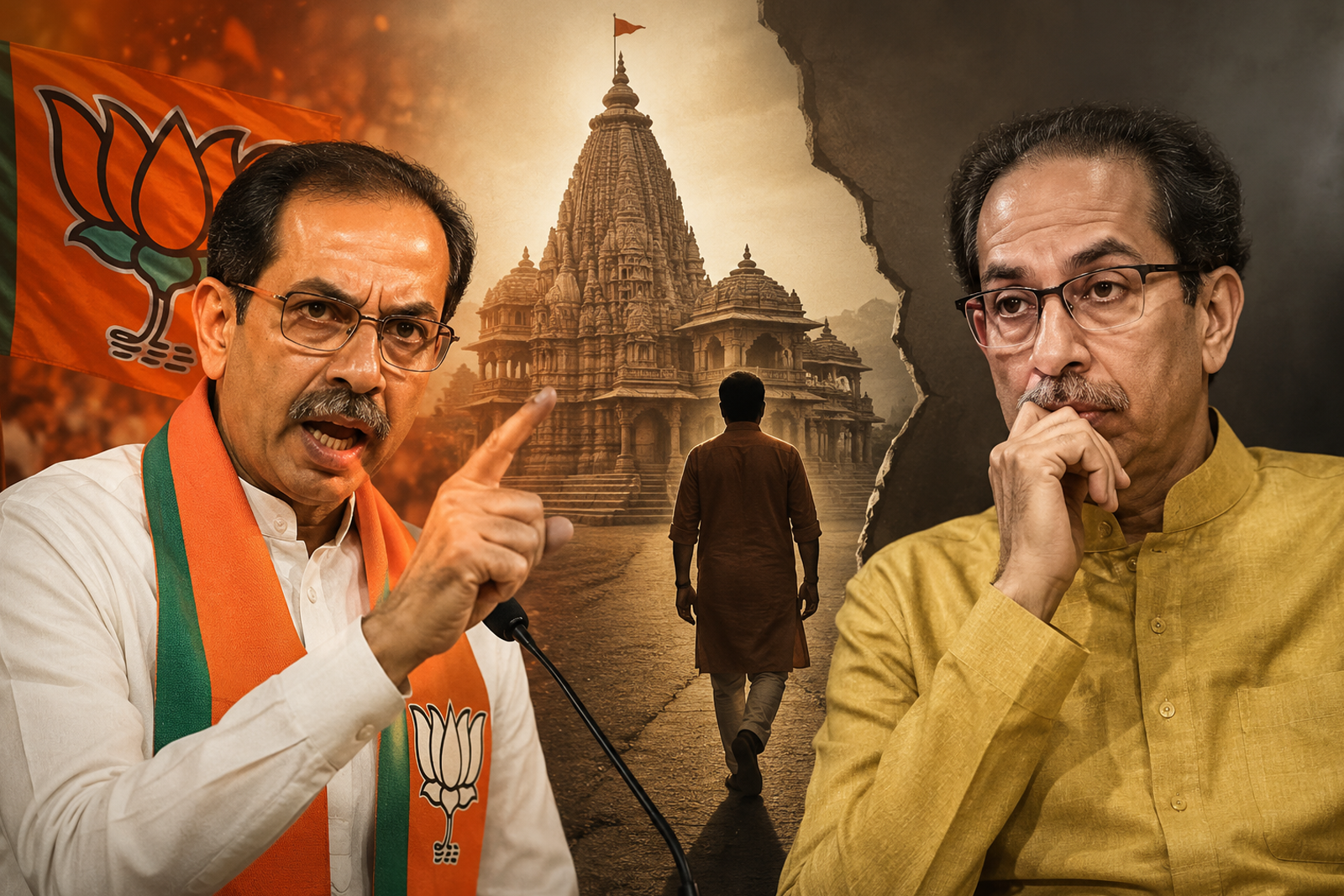
A fresh political exchange has unfolded in Maharashtra after the Bharatiya Janata Party (BJP) responded sharply to comments made by Shiv Sena (UBT) chief Uddhav Thackeray regarding an alleged temple theft issue. BJP leaders rejected the allegations and accused Thackeray of deviating from the ideals associated with Lord Ram, using the phrase "abandoned Ram's path" to criticize his political stance.
The verbal confrontation has added another chapter to the ongoing rivalry between the BJP and the Shiv Sena (UBT), with both parties seeking to strengthen their positions on issues linked to governance, public accountability, and cultural values.
Responding to Thackeray's remarks, BJP leaders dismissed the claims as politically motivated and intended to divert attention from broader issues facing the state. Party spokespersons argued that the BJP has consistently supported the preservation of religious sites and promoted initiatives connected with India's cultural heritage.
According to BJP leaders, attempts to question the party's commitment to temples and faith are misplaced. They maintained that the government's focus remains on transparent administration and the protection of religious institutions.
Uddhav Thackeray raised concerns over the alleged temple theft matter while criticizing the ruling establishment. He questioned whether sufficient action had been taken and urged authorities to ensure accountability. His comments were presented as part of a broader criticism of the government's handling of law and order and the protection of public assets.
The Shiv Sena (UBT) has repeatedly emphasized the need for stronger governance and greater transparency, arguing that issues involving religious institutions deserve prompt investigation.
The latest exchange reflects the increasingly confrontational political atmosphere in Maharashtra. Religious symbolism and references to Lord Ram continue to feature prominently in political discourse, making such statements highly significant during periods of heightened political activity.
Political observers believe both parties are attempting to reinforce their core support base by emphasizing ideological differences while also addressing governance-related concerns.
As the debate continues, attention is expected to shift toward the official response to the alleged temple theft issue and whether further political statements will escalate the controversy. While the BJP and Shiv Sena (UBT) remain divided over the matter, the episode highlights how religious and political narratives continue to intersect in Maharashtra's evolving political landscape.
A fresh political confrontation has emerged in Maharashtra after the Bharatiya Janata Party (BJP) strongly responded to Shiv Sena (UBT) chief Uddhav Thackeray's comments concerning an alleged temple theft issue. The BJP dismissed the accusations and launched a counterattack, accusing the former Maharashtra Chief Minister of having "abandoned Ram's path." The exchange has intensified the political rivalry between the two parties, adding another layer to the ongoing battle for public support in the state.
The controversy has once again placed religious issues at the centre of political discourse, with both parties attempting to present themselves as protectors of public faith while criticizing each other's record on governance and accountability.
The latest dispute started after Uddhav Thackeray questioned the handling of an alleged temple theft case. During his public remarks, he raised concerns about whether authorities had acted swiftly and effectively. He suggested that incidents involving religious institutions should receive immediate attention and transparent investigations.
His statements were widely discussed in political circles, prompting an immediate response from BJP leaders, who accused him of making politically motivated allegations instead of waiting for official findings.
The BJP rejected Thackeray's criticism and claimed that his remarks were aimed at creating unnecessary controversy. Party leaders argued that the BJP has consistently worked to preserve India's religious and cultural heritage while ensuring that legal agencies investigate criminal cases without political interference.
Using the phrase "abandoned Ram's path," BJP spokespersons accused Uddhav Thackeray of moving away from the ideological principles that once formed the foundation of his party. According to BJP leaders, the former Chief Minister has altered his political priorities over the years by aligning with parties that previously opposed his traditional political positions.
The BJP also maintained that isolated criminal incidents should not be converted into political campaigns before investigations reach their conclusion.
Uddhav Thackeray defended his comments by stating that questions regarding the security of temples and religious institutions deserve serious attention. According to leaders from Shiv Sena (UBT), raising concerns about public accountability should not be viewed as political opportunism.
The party argued that any incident involving religious places naturally attracts public interest and therefore requires complete transparency from the administration. It also stressed that citizens expect governments to ensure the safety of places of worship regardless of political considerations.
Religion has long played an important role in Maharashtra's political landscape. References to Lord Ram, temples, and cultural heritage frequently become part of election campaigns and public speeches.
For the BJP, Lord Ram symbolizes cultural identity and national heritage. The party often highlights its initiatives related to temple development and religious tourism as evidence of its commitment to preserving India's traditions.
On the other hand, Shiv Sena (UBT) also has deep historical roots in Hindutva politics. However, political realignments over recent years have created opportunities for the BJP to question whether the party continues to represent its original ideological identity.
This latest exchange reflects that broader ideological contest.
The disagreement comes at a time when political competition in Maharashtra remains intense. Since the split within the Shiv Sena and the formation of separate political factions, every public statement by senior leaders has attracted considerable attention.
Both the BJP and Shiv Sena (UBT) continue to compete for similar voter groups, making ideological debates particularly significant. Political analysts believe that issues connected with religion often resonate strongly with supporters, which explains why both parties respond forcefully to such controversies.
As elections and local political campaigns approach, strong political messaging is expected to become even more frequent.
Beyond political rhetoric, the alleged temple theft case has also raised broader questions about law enforcement and public confidence.
Citizens generally expect authorities to:
Regardless of political affiliations, public trust depends on visible and fair action by investigating agencies.
The exchange between the BJP and Shiv Sena (UBT) has generated discussions among political observers and supporters alike.
Several commentators believe the controversy demonstrates how quickly local issues can evolve into larger political debates. Others argue that attention should remain focused on ensuring justice in the alleged theft case rather than political accusations.
Meanwhile, supporters of both parties have defended their respective leaders through public meetings and social media discussions, further increasing the visibility of the issue.
The BJP's choice of words carries political symbolism beyond the immediate controversy.
By saying that Uddhav Thackeray has "abandoned Ram's path," BJP leaders are attempting to portray him as having departed from the ideological principles traditionally associated with his political career.
The phrase is intended to reinforce the BJP's claim that it remains committed to values connected with Lord Ram while questioning the political direction taken by the Shiv Sena (UBT) leadership in recent years.
Whether this narrative influences public opinion remains to be seen.
The incident could influence political discussions in several ways:
Supporters of both parties may become more vocal as ideological debates continue.
Opposition parties are likely to continue questioning the government's handling of sensitive issues.
Both parties may use the controversy to reinforce their political narratives during future campaigns.
Statements involving religion and prominent political leaders often receive widespread coverage, ensuring the issue remains in public discussion.
The latest confrontation between the BJP and Uddhav Thackeray illustrates the increasingly competitive political atmosphere in Maharashtra. While the immediate trigger was an alleged temple theft issue, the debate has expanded into broader questions concerning ideology, governance, public accountability, and political identity.
As investigations into the alleged incident continue, the political exchange is likely to remain part of Maharashtra's public discourse. Whether the controversy results in lasting political consequences will depend not only on future statements from both parties but also on the progress of official investigations and the public's assessment of the facts.

In today’s world of endless choices and digital noise, marketing is no longer just about promoting products — it’s about creating meaningful connections. Successful brands focus on building relationships rather than chasing transactions. Marketing that connects transforms audiences into loyal communities by earning their trust, understanding their needs, and delivering genuine value. When businesses prioritize people over promotions, marketing becomes more than strategy — it becomes a relationship built to last.

Odisha’s small businesses are entering a new era — where mobile apps, online payments, and e-commerce aren’t luxuries, but lifelines for growth and survival.

As India enters the second phase of its digital revolution, artificial intelligence and automation are not just transforming industries—they’re redefining what it means to work, earn, and adapt.

The conference brought together officials from ten central districts, including district collectors, tehsildars, registrars, and welfare officers, either virtually or in person.

We glorified sleepless nights, burnout, and exhaustion as signs of ambition. But when did working yourself to the edge become the definition of success?

Not everyone who thrives in tech writes code. Some design the very experiences that make technology human.




Leave Comments